


.png?width=200&height=148&name=Menu%20C%20(2).png)
.png?width=307&height=228&name=Menu%20-%20D%20(1).png)





.png)



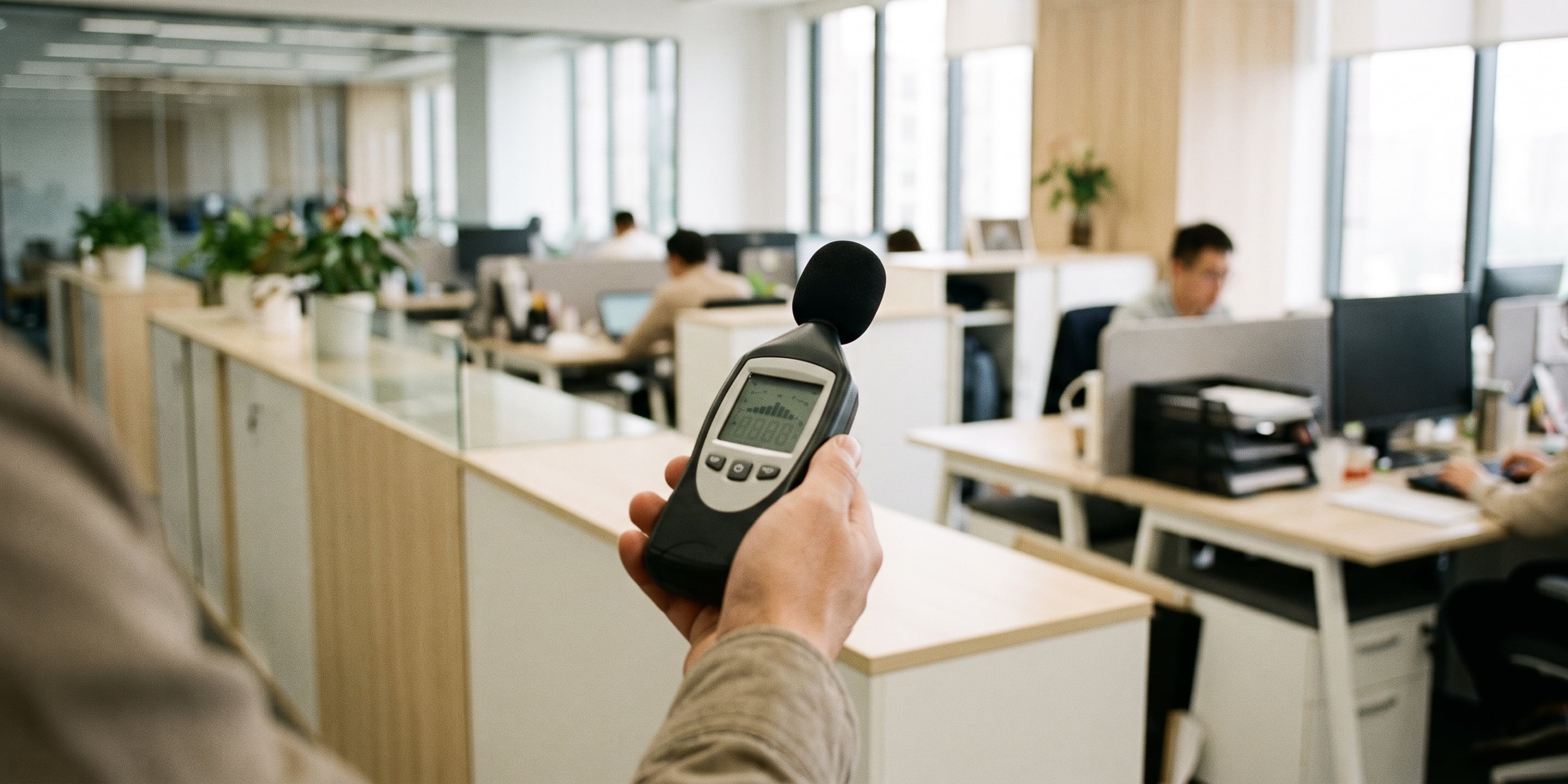
Continuous noise monitoring tracks how loud a space is around the clock, while a handheld sound level meter only tells you how loud it was for the few seconds someone happened to be measuring. A sound level meter is useful for a quick, one-time loudness check, while continuous monitoring is ideal for understanding how a space behaves acoustically over time, which is key for achieving acoustic comfort.
Here's what a sound level meter actually captures, why the timing of that reading can make or break its usefulness, and why continuous monitoring is the only approach that will help you achieve acoustic comfort.
What Does a Handheld Sound Level Meter Measure?
A handheld sound level meter measures the sound pressure level in a space at the moment you point it there, usually expressed in dBA over a reading window of a few seconds to a couple of minutes. In an office environment, that quick reading can be useful for:
- Confirming a room meets a specific noise target during a scheduled facilities walkthrough.
- Checking how loud a specific spot actually is right after someone raises a noise complaint.
- Comparing levels before and after a fix, like new acoustic panels or an HVAC repair.
Most consumer and even professional-grade meters return a single number, an average, or a peak for that short window, rather than an ongoing record of how a room's sound changes over the course of a day.
How Does Continuous Noise Monitoring Compare to a Sound Level Meter?
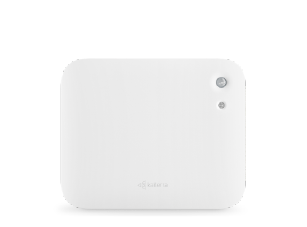
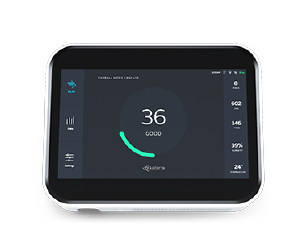
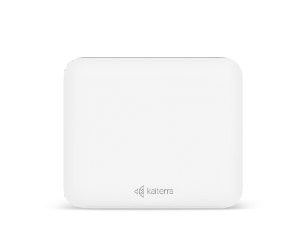
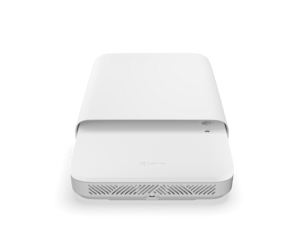
A continuous noise monitor is a sensor that stays in place and logs sound levels around the clock, typically every minute, without anyone needing to be there to take a reading. Instead of one number for one moment, it builds an ongoing record of how a space actually sounds over hours, days, and weeks, catching the quiet stretches, loud spikes, and shifting frequency content that a single reading misses.
Here's how that stacks up against a handheld sound level meter:
|
Handheld Sound Level Meter |
Continuous Noise Monitor |
|
|
What it captures |
A single decibel reading over seconds to minutes |
An ongoing stream of sound level, variability, and frequency |
|
When it's taken |
Whenever someone walks over and takes it |
Around the clock, with nobody needing to be present |
|
What it shows |
One number for one moment |
Trends, peaks, and how sound changes over hours, days, or weeks |
|
Best suited for |
A quick compliance check or one-time walkthrough |
Diagnosing a recurring complaint or tracking acoustic comfort over time |
What Are the Limitations of a Spot Measurement With a Sound Level Meter?
A spot measurement has four limitations working against it: when it happens to be taken, how little it actually captures, what it misses about the sound's makeup, and how loosely that number tracks what people in the room actually notice.
- Timing. A spot reading only reflects whatever is happening in that exact moment. A facilities team that walks in with a meter during a lull gets a perfectly accurate, yet misleading, reading. A second visit an hour later during a busier stretch can produce an entirely different number from the same room.
- A single decibel number. Most spot readings return one averaged dBA figure for the session, not how that noise actually behaves over time. A related body of research on noise and sleep prepared for the World Health Organization makes a similar point about how noise should be counted in the first place: tallying individual noise events, not just averaging decibel levels, predicts real-world disruption better, because two spaces with the same average reading can behave completely differently depending on how that noise actually arrives.
- Doesn't capture the full character of the sound. A dB number can't tell you what a room's noise is actually made of. Sound has more than one dimension: how much it swings between loud and quiet (variability), when and how high it peaks, what the background sound level is like, and what frequencies make it up.
A single reading catches none of these. One study held two noises at the same 40 dBA and varied only the frequency mix, and the low, rumbling one measurably worsened proofreading and reasoning across the group and blunted the normal cortisol dip in noise-sensitive people, according to research published in Life Sciences. - Doesn't correlate to how people actually feel. One study tested three different loudness-based metrics, sound level, Noise Criteria (NC), Room Criteria (RC), and Balanced Noise Criteria (NCB), and found that none of them correlated significantly with how satisfied occupants actually were with background noise in their workspace. Loudness alone, no matter how it was calculated, wasn't enough to explain how the space was actually performing acoustically, according to research published in Buildings.
A sound level meter still has its place: it's fast, inexpensive, and good enough for a quick check. But the only way to comprehensively assess an office's acoustic environment over time and throughout fluctuating conditions is to monitor it continuously.
Want to Learn More About Continuous Noise Monitoring for Your Office?
If your goal is to create a high-performing, acoustically comfortable workplace, reach out to us today to learn more about what continuous noise monitoring could look like for your office.