

.png?width=200&height=148&name=Menu%20C%20(2).png)
.png?width=307&height=228&name=Menu%20-%20D%20(1).png)





.png)



What Are the Hardware Requirements for IAQ Monitors for LEED v5?
Not all sensors are created equal. LEED v5 mandates that projects use hardware that has been third-party verified for accuracy. Using unverified "smart home" devices will not qualify for these credits. Devices must meet the criteria for either:
- RESET Air Grade B: A rigorous standard for commercial-grade monitors that tests for data accuracy and consistency in real-world environmental conditions.
- UL 2095 Grade B: A performance and validation standard that evaluates stationary air quality sensors for measurement accuracy, repeatability, and reliability.
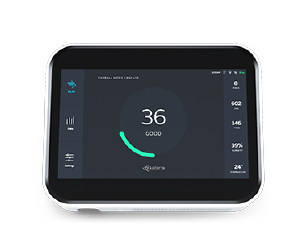
Note: Kaiterra monitors are all RESET Air Grade B certified and can be used for LEED v5.
Which IAQ Parameters Are Required in LEED v5?
For LEED v5 O+M, which provides 10 points for monitoring indoor air quality (IAQ), your continuous monitors must track:
- Carbon Dioxide (CO2):
- Why: Used to measure ventilation effectiveness, especially as occupancy fluctuates throughout the day.
- Requirement: The sensor must provide the 95th percentile value.
- Particulate Matter (PM2.5):
- Why: Used to detect filtration issues and the infiltration of outdoor pollution (like wildfire smoke).
- Requirement: The sensor must provide the daily average.
- Total Volatile Organic Compounds (TVOC):
- Why: Used to identify chemical pollutants from off-gassing materials, cleaning products, or fragrances.
- Requirement: The sensor must provide the daily average.
Note: For BD+C and ID+C projects, temperature and relative humidity sensors are also typically required alongside these three pollutants to earn points for continuous IAQ monitoring.
For a full breakdown of how these parameters earn points in the standard, read our comprehensive guide to IAQ monitoring in LEED v5.
What Are the Accuracy, Resolution, and Range Requirements for Sensors?
To ensure the data you collect is reliable enough for certification, your sensors must meet specific performance thresholds from industry standards.
The table below outlines the minimum accuracy, resolution, and range requirements as defined by the RESET Air Grade B standard, which serves as a primary benchmark for data quality in LEED v5. Devices certified under UL 2095 are tested to comparable rigorous standards to ensure they deliver this level of precision.
|
Parameter |
Sensor Output Resolution |
Measuring Range |
|
|
CO2 |
400-2,000 ppm: ±50 ppm & ±3% 2,000-5,000 ppm: ±50 ppm & ±5% |
5 ppm |
400-5,000 ppm |
|
PM2.5 |
0-150 µg/m3: ±5 µg/m3 & ±15% 150-500 µg/m3: ±5 µg/m3 & ±20% |
1 µg/m3 |
0-500 µg/m3 |
|
TVOC |
65-260 ppb: ±8.7 ppb & ±15% 260-870 ppb: ±8.7 ppb & ±20% |
4.4 ppb |
65-870 ppb |
Need Help Selecting an Air Quality Monitor for LEED v5?
Reach out today to connect with a LEED AP on the Kaiterra team!