

.png?width=200&height=148&name=Menu%20C%20(2).png)
.png?width=307&height=228&name=Menu%20-%20D%20(1).png)





.png)



If you manage a building or workplace, you may have come across terms like RT60, STC, or NRC on acoustic spec sheets or building certification guidelines. These are all metrics that evaluate the acoustic performance of a space to help you gauge whether that space holds up to its design intent.
In this article, we'll break down what these metrics are, what thresholds various standards require, and how you can use that data to verify workplace performance.
What Is Reverberation Time (RT60)?
Reverberation time, or RT60, is how long it takes sound to fade out after it's made, like a phone ringing or someone talking, until it drops to a level 60 decibels quieter than when it started. It's measured in seconds, which is where the name comes from. A long RT60 means sound lingers and overlaps with whatever gets said next, so words blur together and conversations get harder to follow.
How Is RT60 Measured?
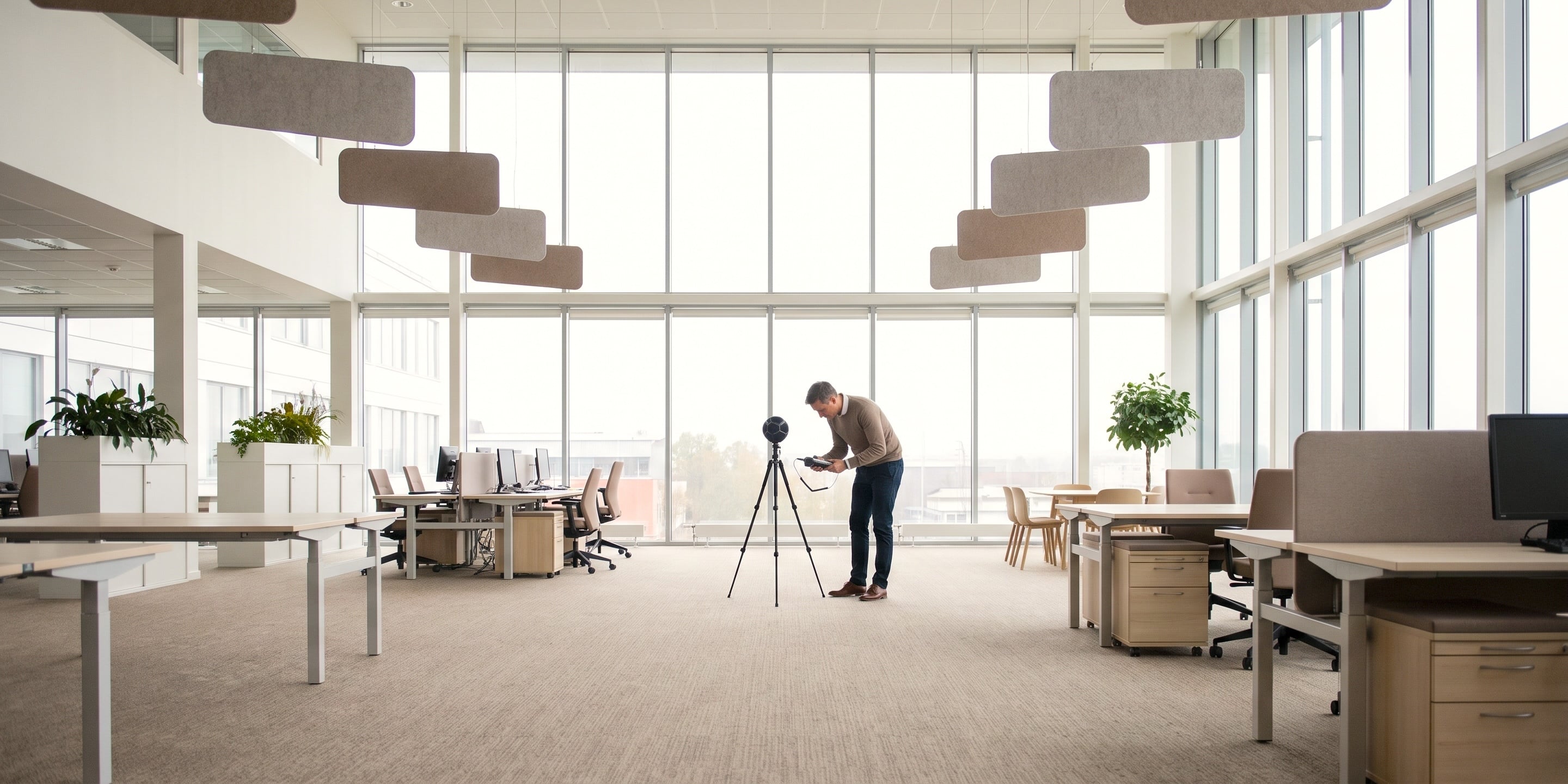
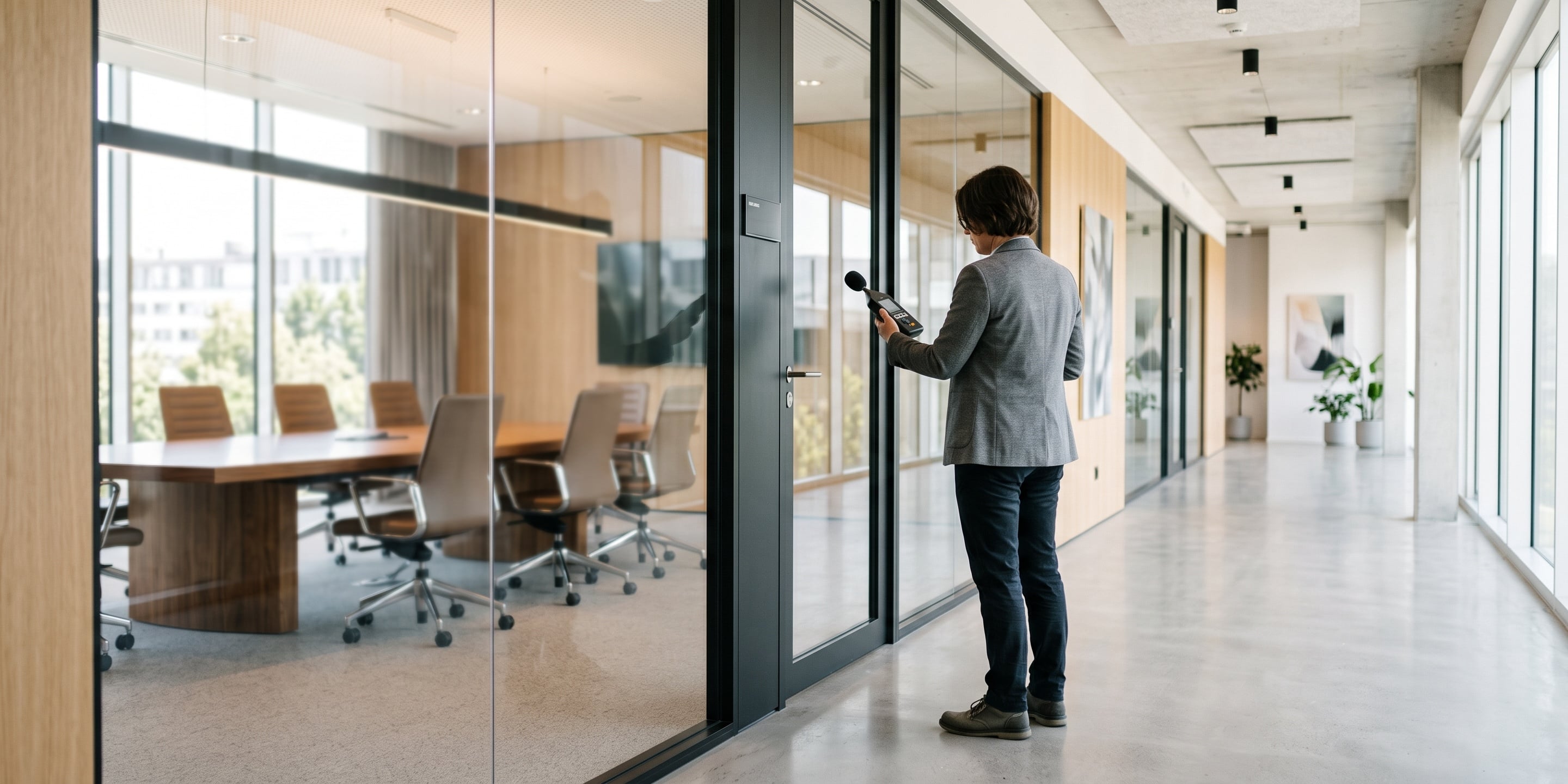
An acoustician tests RT60 with a calibrated sound source and a sound level meter in an empty room, following the international ISO 3382-2 standard for everyday rooms like offices. They fill the room with a burst of loud, steady noise from an omnidirectional speaker, then cut the sound off and track how quickly the level falls on the meter.
In most rooms, background noise makes it hard to isolate a full 60 decibels of clean decay, so the acoustician measures a shorter, cleaner portion of the drop and calculates the rest mathematically.
What's a Good RT60?
At Kaiterra, our focus is creating built environments that support health and well-being, so we use the WELL Building Standard, the leading healthy building certification, as our main reference point for these thresholds. WELL's Reverberation Time feature (S04) sets a maximum RT60 by room type, and for some room types, by room volume as well:
|
Room Type |
Room Volume |
Max RT60 |
|
Learning, lectures, and conferencing |
Under 10,000 ft³ |
0.6s |
|
10,000-20,000 ft³ |
0.8s |
|
|
Over 20,000 ft³ |
1.0s |
|
|
Areas with regularly used PA systems |
— |
1.5s |
|
Dining areas |
— |
1.0s |
|
Fitness areas |
Under 10,000 ft³ |
0.8s |
|
10,000-20,000 ft³ |
1.1s |
|
|
Over 20,000 ft³ |
1.8s |
|
|
Music rehearsal areas |
Under 10,000 ft³ |
1.1s |
|
10,000-20,000 ft³ |
1.4s |
How Do You Use an RT60 Measurement?
A number that comes in above target for the room's size points toward adding more sound-absorbing material - acoustic panels, ceiling tiles, carpet, and upholstered furniture - not sealing the room better or adding a heavier door, since that solves a different problem (see STC below). Compare your measured number against the targets above, or the room's original design spec, before deciding how much treatment to add.
What Is a Sound Transmission Class (STC) Rating?
A sound transmission class rating, or STC rating, is a single number that rates how well a wall, door, or window blocks sound from passing between two spaces, like a conference room and the open floor next to it. The higher the rating (ranges from roughly 20 to 60+), the more sound stays on its own side, and it's the number to check when comparing partition options or figuring out why a "soundproof" room isn't actually keeping sound inside.
How Is an STC Rating Measured?
An acoustic test system, consisting of a calibrated loudspeaker source on one side of a wall or door paired with a sound level meter and precision microphone on the other, plays sound at different pitches and measures how much comes through, then combines the results into a single rating using a standardized test method.
That number assumes ideal conditions, though. A wall built on a real construction site, with gaps, outlet boxes, and a space above the drop ceiling that sound can sneak through, usually performs a bit worse once it's actually installed. Acousticians can test a finished wall on-site to check for that gap between paper and reality.
What's a Good STC Rating?
WELL's Sound Barriers feature (S03) sets minimum STC ratings, or its international equivalent Rw (Weighted Sound Reduction Index), by what's on each side of the wall:
|
Wall Is Between... |
Minimum STC |
|
Loud zones and regularly occupied spaces |
60 |
|
Areas for conferencing, learning, or sleeping and other regularly occupied spaces |
55 |
|
Adjacent quiet zones |
50 |
|
Rooms for concentration and other regularly occupied spaces |
45 |
|
Circulation zones and regularly occupied spaces |
40 |
A conference room wall rated 55 or higher is a good sign it's actually delivering the privacy it's supposed to.
How Do You Use an STC Rating?
Compare a wall or door's rated STC to what the space actually needs to feel private, using the WELL targets above as a guide. A rating that falls short usually means adding mass or sealing gaps - such as adding extra drywall layers, installing door gaskets, and sealing outlets or the space above a drop ceiling - not adding acoustic panels, since that fixes echo (see NRC below), not leakage.
What Is a Noise Reduction Coefficient (NRC) Rating?
The noise reduction coefficient rating, or NRC rating, describes how much sound a material soaks up instead of bouncing back into the room. It's given as a number from 0.0 (reflects almost everything, like a bare glass wall) to 1.0 (absorbs almost everything, like a thick, soft panel).
How Is an NRC Rating Measured?
A lab tests a sample of the material - a section of ceiling tile, an acoustic panel, a piece of carpet - inside a room built to be highly reflective on its own, comparing how quickly sound fades with the material in versus out to work out how much it absorbs. Those results get averaged into a single rating using a standardized calculation. In practice, you'll usually just see the finished rating on a spec sheet, not the underlying test data.
What's a Good NRC Rating?
WELL's Sound Reducing Surfaces feature (S05) sets minimum NRC ratings, or its international equivalent Alpha-w (αw), by room type and surface, in two tiers depending on how much of the space gets treated:
|
Room Type |
Surface |
Tier 1 NRC Rating |
Tier 2 NRC Rating |
|
Open workspaces |
Ceiling |
0.75 on at least 75% of ceiling area |
0.90 across the full ceiling |
|
Between workstations |
N/A |
Partial-height barriers at least 4 ft above the floor, with a minimum NRC or Alpha-w value of 0.70 between opposing desks |
|
|
Conferencing and learning areas |
Ceiling |
0.75 on at least 50% of ceiling area |
0.90 across the full ceiling |
|
Walls |
0.75 on at least 25% of one wall |
0.80 on at least 25% of two perpendicular walls |
|
|
Dining areas |
Ceiling |
0.75 on at least 50% of ceiling area |
0.90 across the full ceiling |
Ceilings carry the strictest full-credit targets across every room type since they're usually the largest uninterrupted surface and do most of the work controlling echo.
How Do You Use an NRC Rating?
If an existing room already feels loud or echoey, the fix is adding more absorptive coverage where the targets call for it. Treat more ceiling area, install more wall panels, or add soft furnishings, rather than sealing gaps or adding mass, since that's an STC fix, not an NRC one.
Ceiling tiles, acoustic panels, carpet, and workstation partitions are the products most likely to carry an NRC rating. It’s important to check a material's NRC rating against verified thresholds like WELL’s before specifying it for a new space or renovation, since swapping in higher-rated ceiling tiles or panels after installation is far more disruptive than getting it right up front.
Note that NRC is easy to confuse with STC since both show up on the same spec sheets, but NRC softens the echo inside a room while STC keeps sound from leaking into the next one, so a glass wall can carry an excellent STC rating while doing almost nothing to soften the room's echo.
Recap: The Difference Between RT60, STC Rating, and NRC Rating
|
Metric |
What It Measures |
Scale |
WELL v2 Target (Typical Office) |
|
RT60 (Reverberation Time) |
Time for sound to decay by 60 dB after a source stops |
Seconds |
≤ 0.6-1.0s for conferencing/learning, by room size |
|
STC Rating (Sound Transmission Class) |
Airborne sound blocked by a wall, door, or window |
Single rating from 20 to 60+; higher = more blocking |
55+ for conferencing/learning walls |
|
NRC Rating (Noise Reduction Coefficient) |
Amount of sound a material absorbs vs. reflects |
Single rating from 0.0 to 1.0; higher = more absorption |
0.90 across the full ceiling, with slightly lower ratings for wall panels and workstation partitions |
Can a Continuous Sound Monitor Measure RT60, STC, and NRC?
No, RT60, STC, and NRC are one-time tests done as part of a professional acoustic survey, measured in an unoccupied room, typically right after construction or renovation, or for a certification submission.
That survey, however, provides a solid starting point for a continuous monitoring solution implemented afterwards to track day-to-day acoustic comfort via sound level, variability, and frequency. Pairing a continuous monitor with a full acoustic survey that captures RT60, STC ratings, and NRC ratings is the best way to get a 360° view of your space's acoustic performance.
Learn More About Measuring and Optimizing Acoustic Comfort in Your Workplace
Kaiterra specializes in indoor environmental quality (IEQ) monitoring solutions that provide the continuous data and analytics you need to create and maintain a high-performance workplace. Connect with a member of our team today to learn more about how we can help you achieve acoustic comfort in your space.