

.png?width=200&height=148&name=Menu%20C%20(2).png)
.png?width=307&height=228&name=Menu%20-%20D%20(1).png)





.png)




Reducing office noise starts with figuring out what's actually causing it, not buying the first solution that promises quiet and hoping it's the right one. Office noise isn't a simple quiet-versus-loud binary: acoustic comfort depends on loudness, frequency, and how much a space's sound level swings over the day, and each factor creates a different kind of disruption that calls for a different solution.
In this article, we’ll explain the right approach to treating workplace noise, different methods for measuring and treating it, and where personal fixes and office layout changes fit in.
Why Doesn't the Obvious Fix Always Work?
The obvious fix often fails because most noise interventions solve one specific problem, and installing one without knowing which problem you have can leave the noise unchanged or make it worse. Acoustic panels absorb reflected sound, but they do nothing for a low hum coming through the HVAC system. White noise or masking helps cover ambient speech, but it won't quiet a noisy printer.
Even a well-intentioned fix can backfire. The U.S. General Services Administration (GSA) reports that taller partitions, installed to block noise, actually made people feel more isolated and led them to raise their voices, adding to the problem they were meant to solve.
Loudness alone doesn't point to the right fix either. A 2022 study in Buildings measured sound level and three separate noise-rating metrics in real offices and found none of them were significantly correlated with occupant satisfaction. A single decibel reading can tell you a room is quiet on paper while missing what's actually bothering the people in it, which is why the correct first step for any sound treatment solution is to measure every aspect of the acoustic environment.
What Should You Measure Before Choosing a Fix?
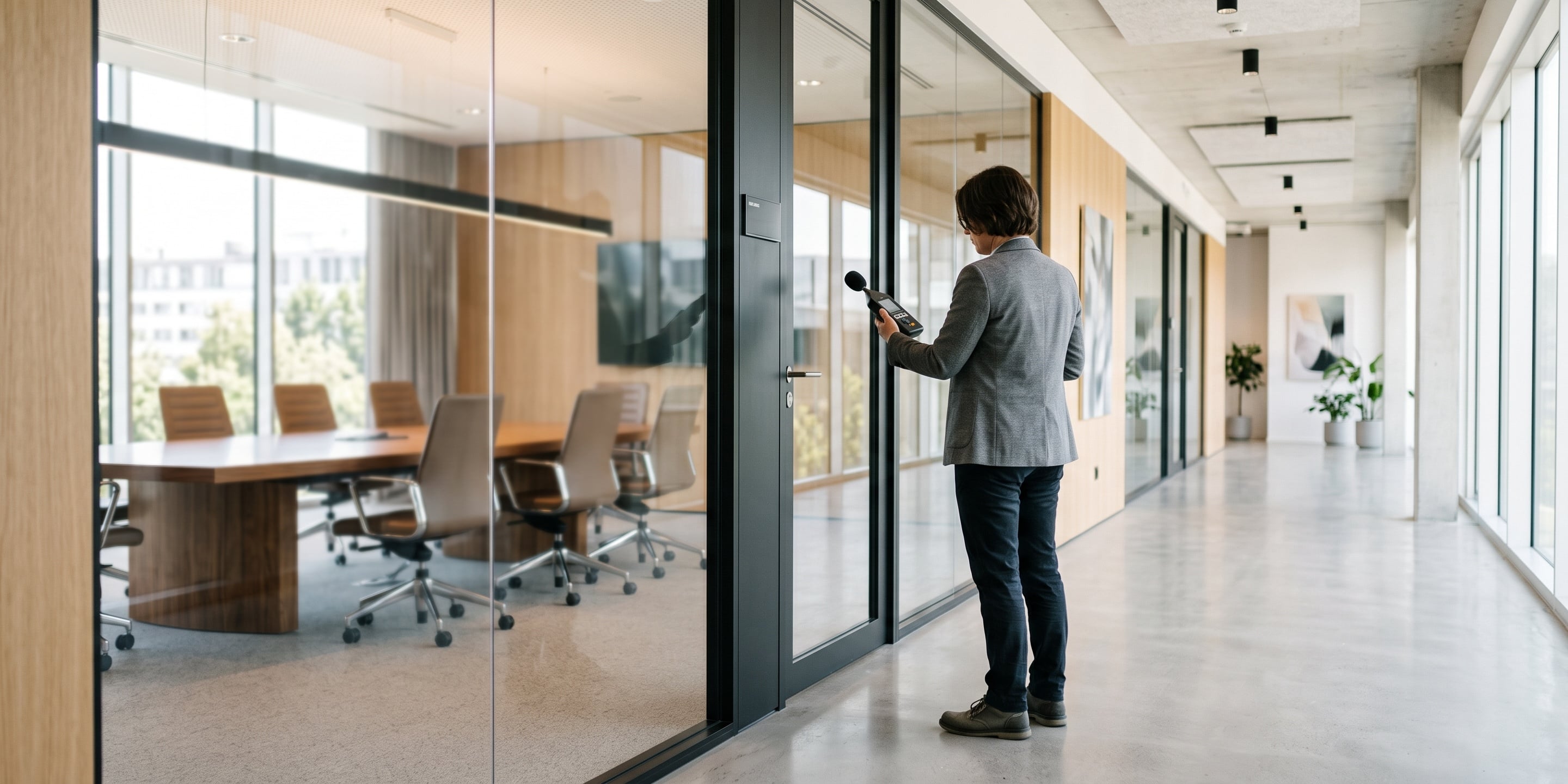
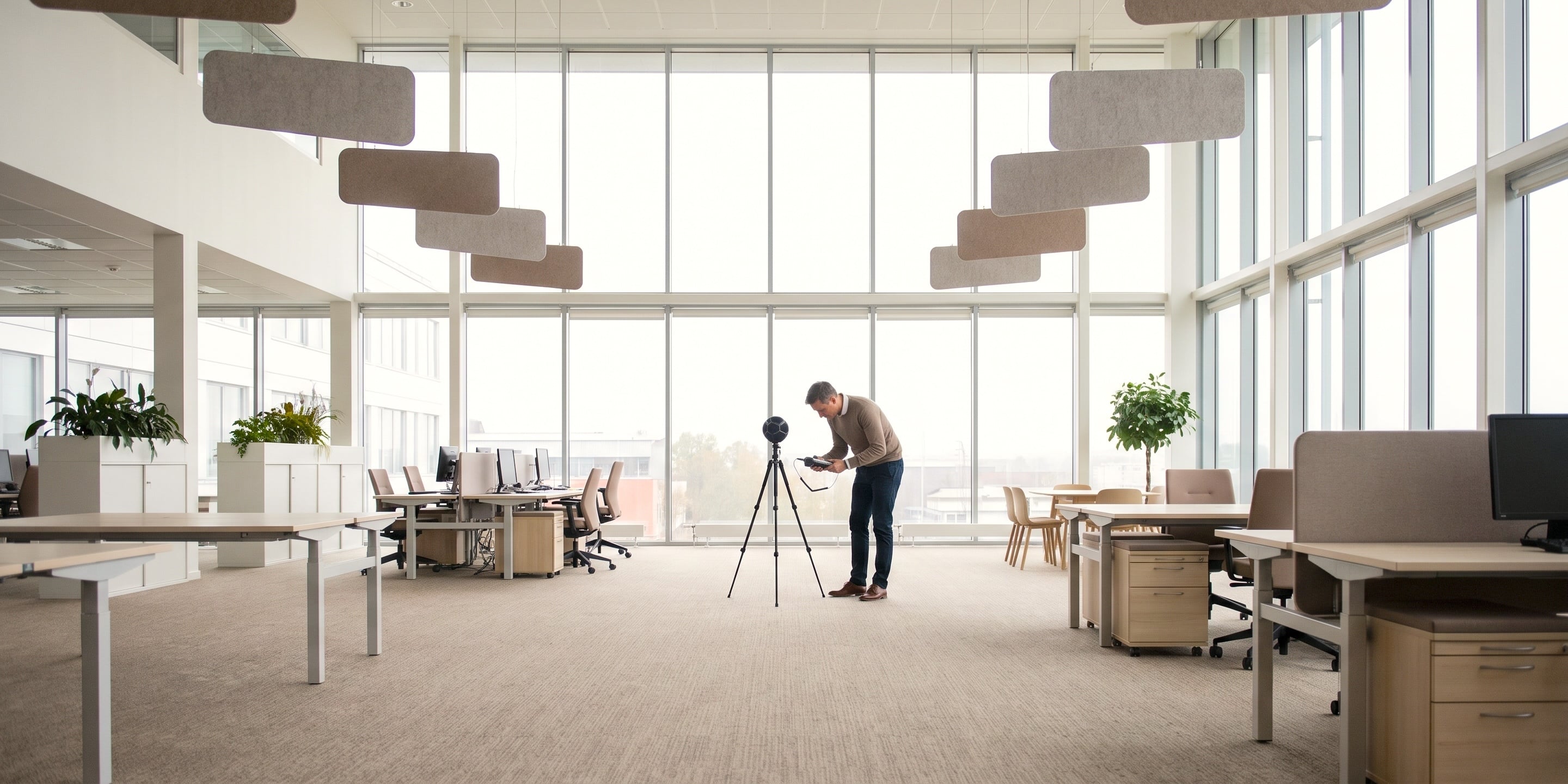
Before choosing an office noise solution, you should ideally measure your space in two different ways: a one-time acoustic survey for parameters like reverberation and sound transmission, and continuous sound monitoring for sound level, frequency spectrum, and variability over time. Those are the two categories of office noise measurement, and each answers a different question.
A professional acoustician runs an acoustic survey on-site with specialized equipment, typically covering:
- Reverberation time (RT60): how long sound and echo persist in a room after the source stops
- Absorption (NRC): how much sound a room's surfaces and materials soak up versus reflect back
- Sound transmission and insulation (STC): how well walls, floors, and doors block sound from moving between rooms
- Speech intelligibility and distraction distance: how far and how clearly a conversation carries across a space
- Frequency and octave-band analysis: which specific frequency bands dominate a room while it’s empty
- Background noise levels against a design target: whether the room's built acoustic performance matches what it was actually designed for
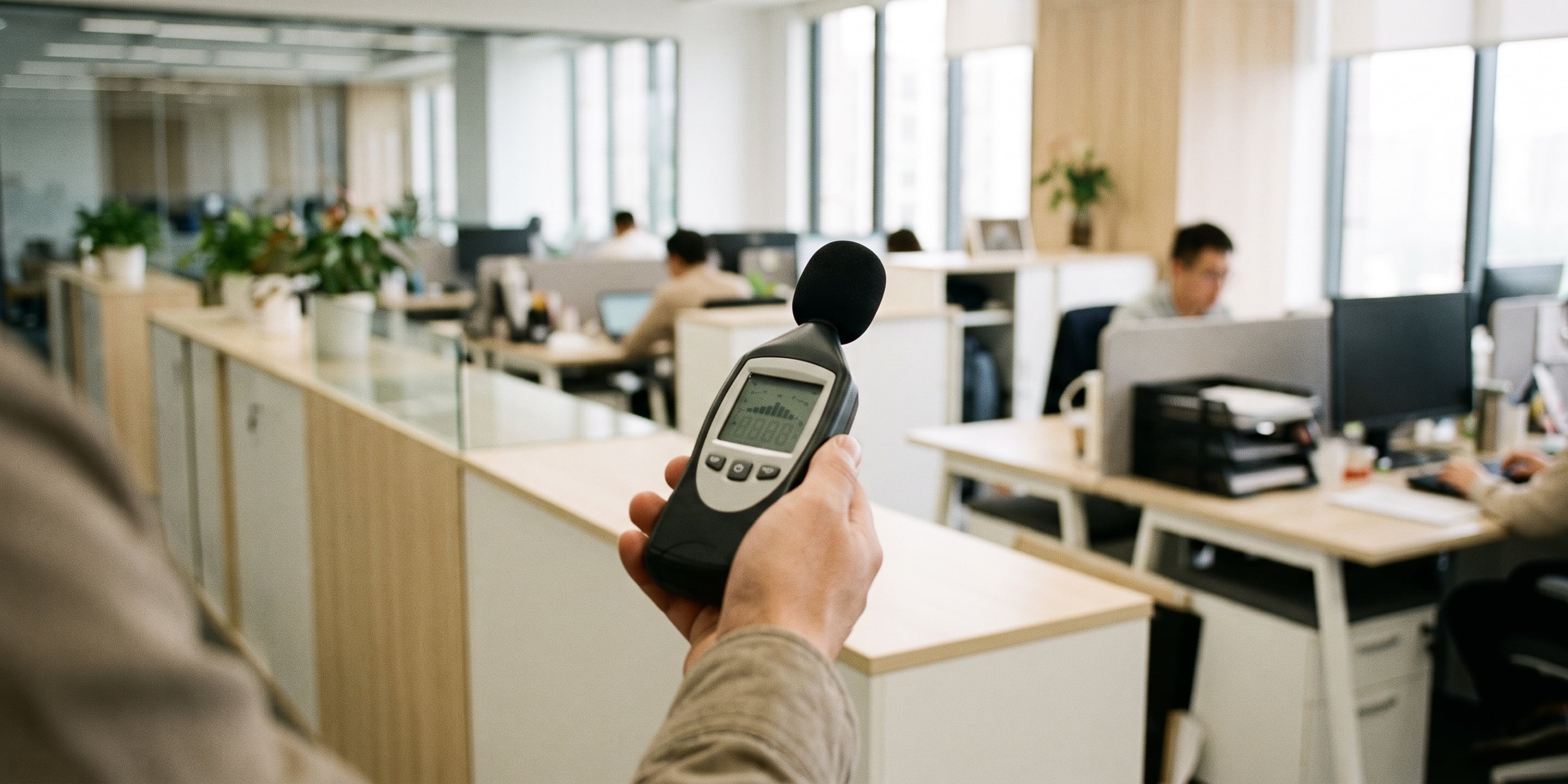
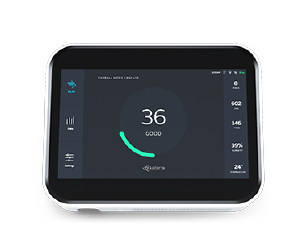
An acoustic survey only measures those metrics once, typically in an empty room. If you want ongoing data about how your office actually handles noise once it's occupied, you can only get that from continuous sound monitoring. A comprehensive continuous monitoring solution should tell you:
- Sound level (LAeq and LAmax): LAeq is the A-weighted equivalent level, the energy-averaged loudness of a space over a given period, and the number most people mean when they ask how loud a room is. LAmax is the highest level reached in that same period, which catches a single loud event - a dropped object, a slammed door, an alarm - that an average would miss.
- Weighting (LCeq and LZeq): the same average recalculated on a flatter frequency curve that doesn't discount low frequencies the way A-weighting does. A wide gap between LAeq and LCeq, or the fully unweighted LZeq, points to low-frequency sound content (HVAC rumble being the common culprit) that an A-weighted reading alone hides.
- Frequency content: broken into dozens of narrow frequency bands spanning roughly 20 Hz to 20,000 Hz, the range of human hearing, rather than collapsed into one overall number. That's what lets a system tell a low-frequency rumble apart from a high-pitched tonal whine.
- Variability (LA10 and LA90): LA10 is the level exceeded only 10% of the time - the loud, intrusive moments. LA90 is the level exceeded 90% of the time - the steady background. The gap between them separates a room that's loud but predictable from one that's quieter on average yet constantly interrupted.
An acoustic survey is most useful right after construction, a renovation, or when you need to diagnose a specific problem like an echo or a wall that isn't blocking sound the way it should, confirming whether the room's built performance matches its design intent.
Continuous monitoring picks up where a survey leaves off: it lets you catch ongoing issues as they happen, pinpoint which zone and time of day they're occurring, and confirm that a fix keeps working after the room fills back up with people, equipment, and daily use.
How Do You Diagnose a Specific Noise Complaint?
You diagnose a specific noise complaint by identifying which acoustic problem it points to, then confirming it with the metric that measures that problem. Here's how common complaints break down:
|
Acoustic problem or complaint |
How to diagnose it |
How to fix it |
|
Conversations echo and the room feels loud even when nobody is talking loudly |
Acoustic survey: reverberation (RT60) |
Absorb |
|
Speech carries clearly from several desks away |
Acoustic survey: speech intelligibility and distraction distance |
Block or Cover |
|
Meeting room conversations are audible in the next room or on the next floor |
Acoustic survey: sound transmission and insulation |
Block |
|
People notice a low hum or rumble they can't quite place |
Continuous monitoring: the gap between LCeq or LZeq and LAeq, plus frequency content |
Absorb or block the source once it's located |
|
A space feels loud and unpredictable even though the average level seems fine |
Continuous monitoring: the gap between LA10 and LA90 |
Cover, or a layout and zoning change |
|
Complaints keep coming in, but a one-time walkthrough or spot check found nothing wrong |
Continuous monitoring: sound level and variability tracked over days, not a single visit |
Depends on what the ongoing data actually shows |
How Do You Fix Office Noise Once You've Measured It?
Acoustic interventions fall into one of three categories, which the GSA calls: Absorb, Block, and Cover (ABC):
|
Approach |
What it fixes |
Example interventions |
|
Absorb |
Echo and reflected sound bouncing around a hard-surfaced room |
Acoustic panels, ceiling baffles, carpet and carpet underlay, plants, soft furniture |
|
Block |
Sound traveling between spaces or across a floor |
Partitions, enclosed rooms, sound-rated walls and doors, phone booths and acoustic pods, moving noisy equipment like printers or copiers away from workstations |
|
Cover |
Speech and other noise that's still intelligible at a distance |
Sound masking systems, white noise machines, background music at a controlled level |
Before choosing a fix, the most important step is to measure first so you can accurately diagnose the problem. Without data on what's actually causing the noise, it's easy to spend money and time treating the wrong problem.
Do Personal Fixes Like Noise-Cancelling Headphones Work?
Partly: noise-cancelling headphones and white noise apps, the fastest fix most people reach for on their own, reduce how annoying noise feels without necessarily addressing the deeper impact.
A 2022 study in Frontiers in Built Environment found active noise-cancelling headphones significantly reduced how annoyed people felt and improved self-rated concentration in a noisy office, across two separate experiments, but the same study found no measurable improvement in actual recall or cognitive test performance.
Headphones are still a valuable tool for making a space feel bearable, but they’re more of a band-aid solution compared to a full acoustic intervention. If many occupants in a room feel the need to wear their own noise-cancelling headphones, that’s a sign that room-level acoustic treatment is needed in that space.
Does Office Layout or Policy Change Help With Noise?
Yes, layout more reliably than policy. Where people sit changes how much noise they're exposed to: a 2020 study in Journal of Environmental Psychology measured cognitive performance among the same employees before and after they moved between zones in a real office, and found that shifting from an active open-plan zone to a quiet zone raised performance by 16.9%, while moving to an individual working room raised it by 21.9%, with the open-plan zone measuring 15 dB louder than the quiet zone.
Grouping collaborative teams near naturally busy areas and keeping quiet zones for focused work away from foot traffic and equipment works because it addresses a measured noise gap, not just a seating preference.
Policy changes are harder to back with controlled research. Quiet hours and headset-first call norms are common in practice, and they target a real problem: a 2025 global workplace survey found a colleague's phone conversation was the single most cited desk distraction, ahead of foot traffic, printers, and outside noise. But whether a specific policy actually reduces noise exposure in your office is still a measurement question, not something to assume works just because it worked somewhere else.
How Do You Know a Noise Fix Actually Worked?
You know a fix worked by comparing measured sound levels before and after the change, not by assuming it. That before-and-after benchmark (the same metrics in the same space) is the main source of truth: did the level, frequency content, or variability actually move? Secondary signals like occupant satisfaction and perceived disruption are worth checking too, but only after the measured data confirms something changed.
A 2008 field study presented at the International Congress on Noise as a Public Health Problem installed a sound masking system in a small open-plan office, raising the measured background level from 35 to 44 dBA, the direct benchmark for whether the fix worked.
Alongside that, two secondary signals also moved: self-reported wasted working time dropped from about 14 minutes a day to 6 minutes, and the radius at which a conversation was distracting shrank from 13.2 meters to 6.2 meters. That's a small sample, but it illustrates the hierarchy: verify the objective level change first, then look at what happened to occupant experience.
Continuous measurement is key here because a treatment can look like it worked right after installation and then drift. Panels get moved, partitions get repositioned, and a masking system's settings can change. Re-measuring that same benchmark over time confirms whether a fix is still holding up, not just whether it worked on day one.
Want to Learn More About How to Reduce Noise in Your Office?
Kaiterra specializes in indoor environmental quality monitoring, including acoustic comfort, so you get ongoing data instead of a one-time snapshot. Reach out to a member of our team today to find out how a continuous sound monitoring solution can help you measure, treat, and optimize your acoustic environment.