

.png?width=200&height=148&name=Menu%20C%20(2).png)
.png?width=307&height=228&name=Menu%20-%20D%20(1).png)





.png)



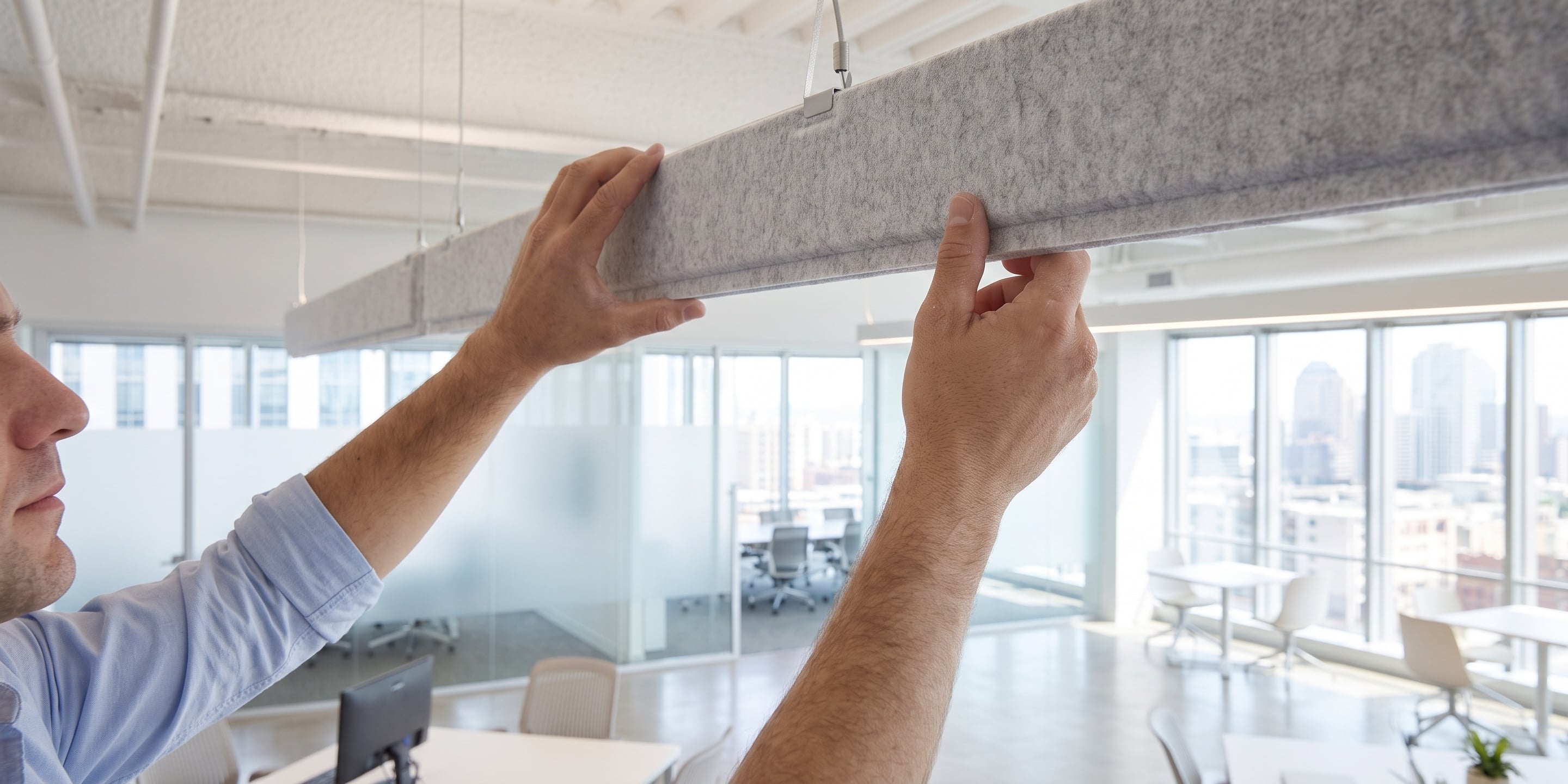
Indoor noise monitoring means continuously tracking sound levels throughout a building instead of checking them once with a handheld meter. For facilities teams already managing temperature, air quality, and a steady stream of tenant complaints, sound is often the one condition nobody measures until someone calls to complain about it.
Here's what an indoor noise monitor actually captures, how to interpret what those readings are telling you, and how a facilities team can use that data to reduce complaints and improve acoustic comfort.
What Is Indoor Noise Monitoring?
Indoor noise monitoring is the continuous measurement of sound level, variability, and frequency content inside a building, rather than a single reading taken at one point in time.
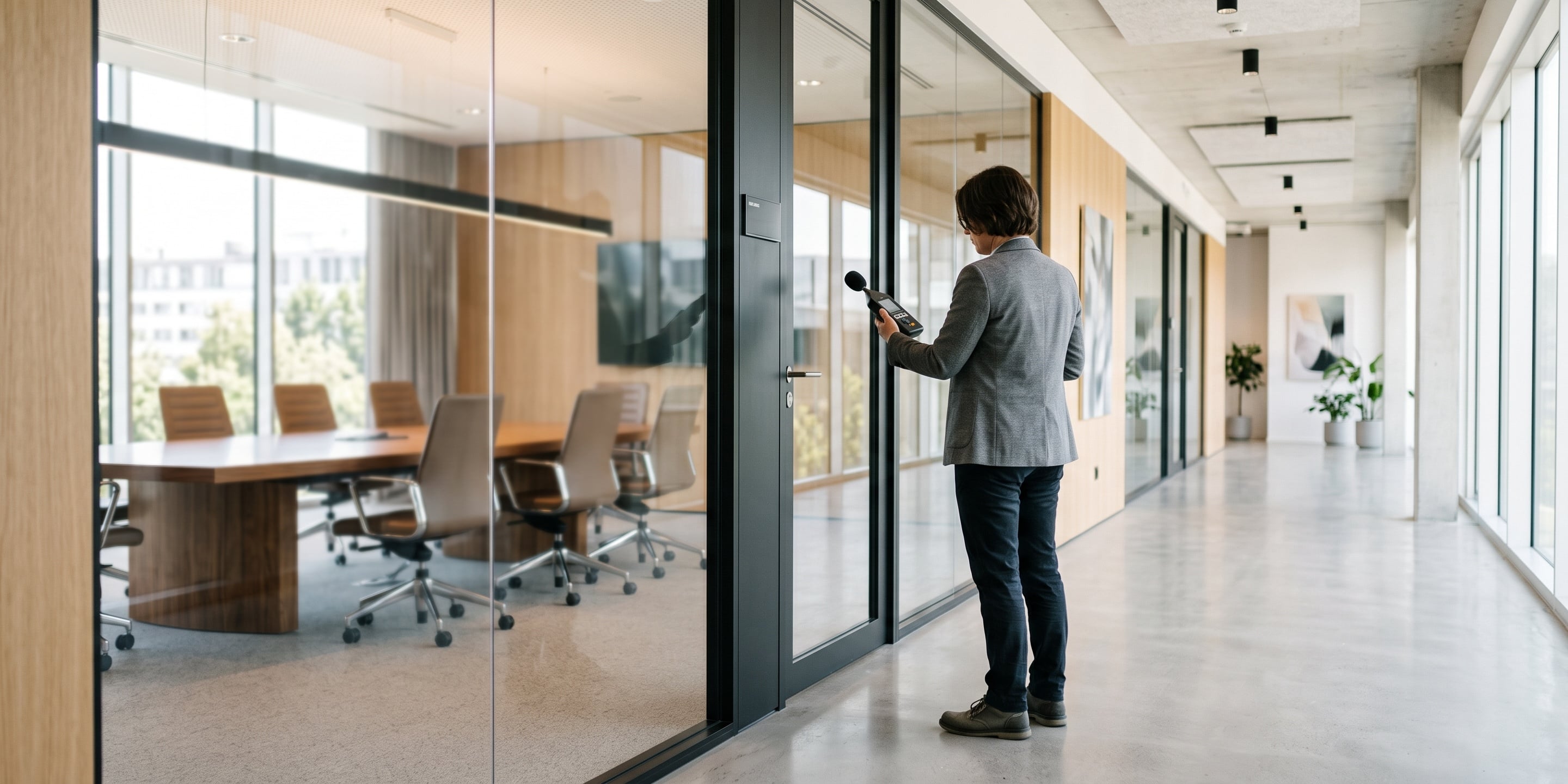
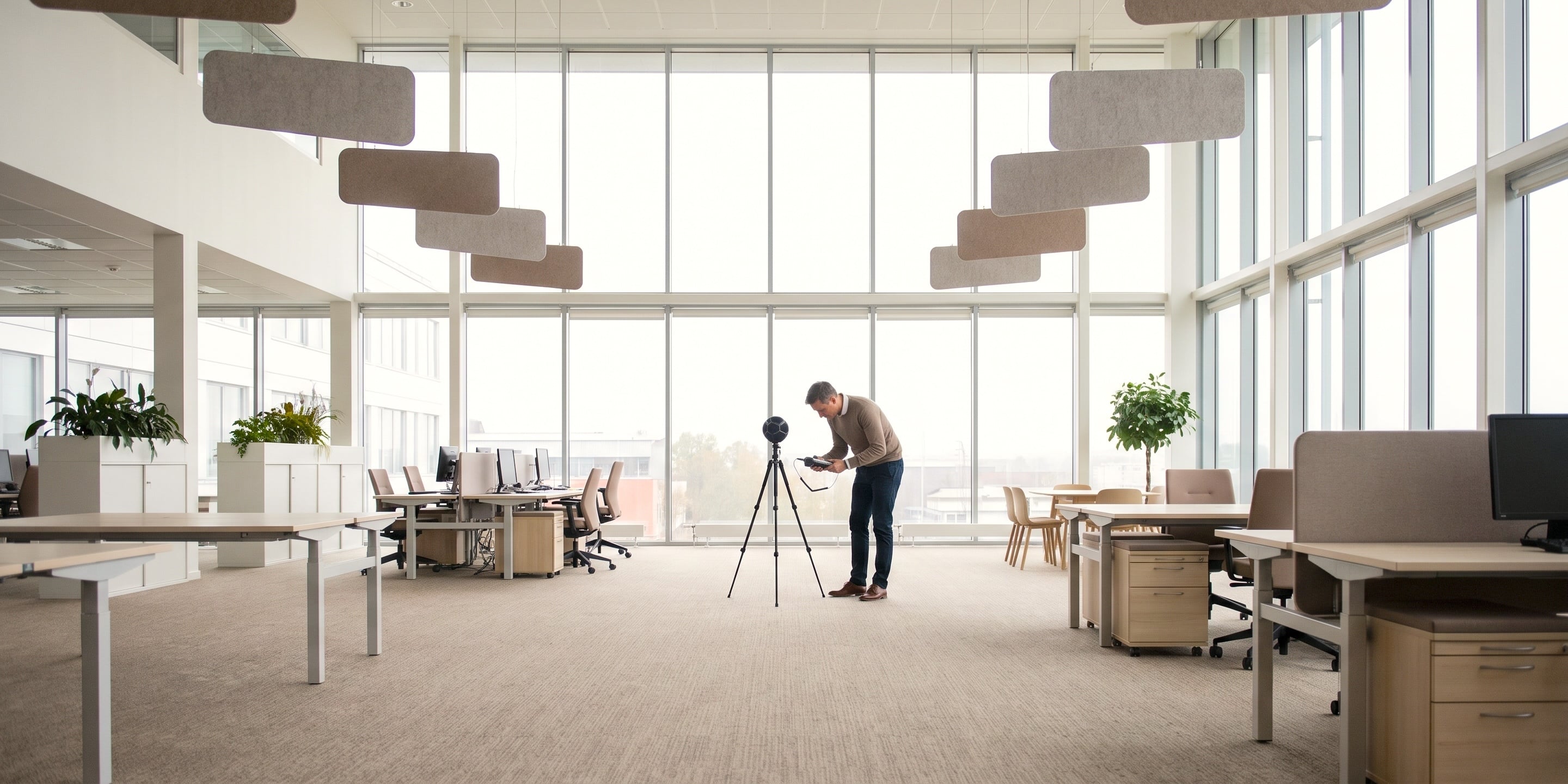
Many facilities teams already do some version of that single-point check: someone walks the floor with a handheld sound level meter and logs a dBA reading at a few desks, or a professional acoustic survey team visits once to assess reverberation time, insulation, and speech privacy for a specific project.
Both of those checks are useful for what they're designed to do, but continuous monitoring takes a different approach. It trends a space the way a building automation system trends temperature, rather than checking it by hand once. Sound in an occupied building rarely holds steady: HVAC cycles on and off, meeting rooms fill and empty, and a construction crew two floors down can spike levels for an afternoon.
That's the pattern a one-time check misses, capturing only what the room sounded like in that single moment rather than how it behaves over hours, days, and seasons.
Why Should Facilities Teams Track Noise Continuously?
Acoustics should be monitored continuously because it is the single biggest source of occupant dissatisfaction in commercial buildings:
- 54% of occupants report dissatisfaction with acoustic conditions, ahead of both temperature (38%) and visual privacy (28%), across more than 62,000 occupants surveyed in 617 buildings, per the UC Berkeley Center for the Built Environment.
- 70% of employees call noise levels an important workplace factor, yet only 35% are satisfied with it, according to Leesman's analysis of over 600,000 employee responses.
- 60% of federal office workers said they'd get more done if their workspace were quieter, per the U.S. General Services Administration.
For a facilities team, that means noise complaints are likely already the most common indoor environmental quality (IEQ) ticket in the queue, whether or not anyone has measured why.
Some facilities teams see a noise complaint and assume the room is simply too loud, but that's often not the case. In a study measuring sound level alongside standard acoustic ratings like Noise Criteria (NC) and Room Criteria (RC), none of those single-point metrics correlated significantly with how satisfied occupants actually felt, according to research published in Buildings.
In reality, the two factors most likely behind noise complaints are high sound variability, spikes of loud noise breaking into an otherwise quiet room, and uncomfortable frequencies, like the persistent whine of a fluorescent light ballast or an old refrigerator compressor humming in a break room. A fluctuating sound can carry the same annoyance penalty as one 11 to 12 dB louder, and a persistent tone carries a similar 8 to 12 dB penalty, according to research presented at ICBEN.
The case for multi-parameter noise monitoring lies not only in the fact that you can't fix what you don't measure, but also in the reality that a single decibel reading cannot definitively tell you about the acoustic environment in any given space.
What Noise Parameters Should a Facilities Team Measure?
In order to gain a comprehensive view of the acoustic environment, an indoor noise monitoring setup should track several aspects of sound level, the amount of variability, and what frequencies are present in that sound. Specific metrics include:
- LAeq, the A-weighted average sound level over a given period, weighted to match how the human ear perceives loudness. This is the baseline dBA reading most standards reference.
- LCeq, a C-weighted average that keeps more of the low-frequency energy that A-weighting filters out. This is what catches a rumbling HVAC unit that an LAeq reading alone might miss.
- LZeq, the unweighted (linear) reference reading, with no frequency filtering applied at all. It's used diagnostically to cross-check the A-weighted and C-weighted readings against each other and reconcile the overall sound level against the frequency spectrum.
- LAmax, the single loudest A-weighted moment captured during a measurement period, like a door slam or a raised voice.
- L10, the level exceeded only 10% of the time. It flags intrusive peaks that a straight average smooths over.
- L90, the level exceeded 90% of the time, essentially the quiet background hum of a space once activity spikes are set aside.
- Frequency spectrum, a breakdown of sound by frequency band. It shows whether a problem sound is a low rumble, a mid-range hum, or a high-pitched whine, something no single decibel number can show.
How Do You Diagnose and Address a Noise Problem From These Readings?
The combination of sound level, variability, and frequency readings will help you pinpoint the source of a noise complaint, and different causes call for different fixes. Here are five scenarios you may encounter from the data, and how you can address them:
- A high LCeq relative to LAeq points to low-frequency energy, often a mechanical source like an aging HVAC unit, a resonating duct, or vibration carrying through the structure. This usually calls for a mechanical fix, such as servicing or isolating the equipment, rather than adding sound-absorbing material.
- A narrow spike in the frequency spectrum usually traces back to one specific piece of equipment, a fluorescent light ballast, a fan motor, a compressor, rather than general activity in the space. The fix is identifying and servicing or replacing that one source.
- A high LAmax against a moderate LAeq points to occasional loud events, like a slammed door, a chair scraping across a hard floor, a laugh or raised voice from a nearby desk, layered on an otherwise typical space, rather than a constant source. This usually calls for addressing the specific behavior or fixture behind it - a door closer, chair floor glides, a phone booth - rather than an equipment overhaul.
- A high LAeq with a narrow range between L10 and L90 suggests a steady-state loud condition rather than a specific spike, often tied to layout and density. In an office environment, that usually points to a larger structural fix, like rethinking zoning, adding enclosed spaces, or installing sound-absorbing panels or ceiling baffles, rather than a quick repair.
- A rising L90 over time, without a matching rise in LAeq or LAmax, suggests the background hum of the space itself is creeping up, potentially from a piece of equipment that was left running, a nearby renovation, or absorption in the room degrading. The fix depends on which one it is: turning off or servicing the equipment, coordinating around the renovation, or restoring the space's acoustic absorption, rather than looking for a single new spike.
How Does Continuous Monitoring Fit Into Daily Facilities Operations?
In practice, continuous indoor noise monitoring becomes a normal part of a facilities team's workflow, not a one-off check. That includes:
- Verifying a complaint against real data, rather than a walk-through. If someone reports a loud room, the team can check whether the space has actually been running louder than its typical baseline, or whether that one visit just happened to catch a normal spike, before assuming something needs to change.
- Confirming HVAC or mechanical noise stays within target after a retrofit or commissioning. Rather than relying on a single acceptance test at handoff, the team can confirm the equipment holds that target over weeks of real operating conditions, not just the one afternoon someone happened to check.
- Tracking acoustic conditions as a normal part of IEQ reporting, alongside temperature and air quality, to get a 360º picture of building performance and make holistic optimizations.
- Catching a developing problem before occupants complain about it. A background level that's been drifting upward, or spikes that have grown more frequent, usually shows up in the data well before it turns into a wave of tickets. Addressing it at that point, whether it’s servicing equipment that's already showing wear or adjusting acoustic panel placement to match flexible room utilization, is simpler than responding after the fact.
How to Start Monitoring Indoor Noise in Your Building
If you’re already monitoring other aspects of IEQ like indoor air quality and thermal comfort, adding noise monitoring capabilities can be as simple as adding a new sensor to those monitors.
Curious to learn more? Connect with a member of our team to find out how easy it can be to monitor noise as part of your building’s broader IEQ strategy.