




.png?width=200&height=148&name=Menu%20C%20(2).png)
.png?width=307&height=228&name=Menu%20-%20D%20(1).png)





.png)


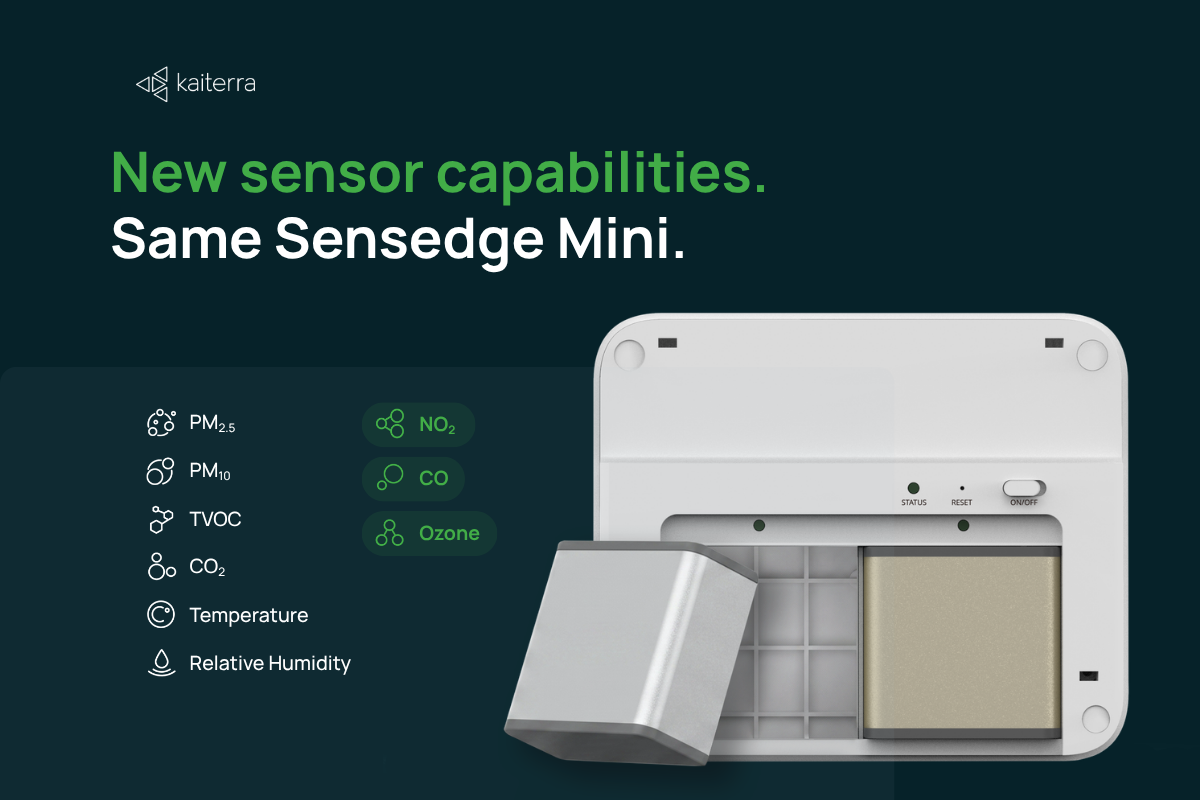
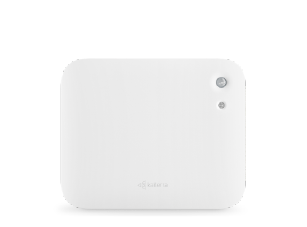
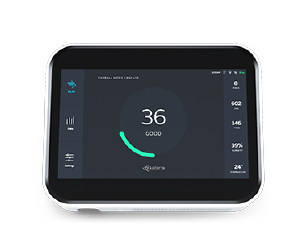
Kaiterra has released a new sensor module for the Sensedge Mini, adding the capability for continuous ozone, nitrogen dioxide, and carbon monoxide monitoring. The Sensedge Mini now measures every parameter required in WELL’s Air and Thermal Comfort concepts, meaning that certifying projects now have a wired continuous monitoring solution as an alternative to annual on-site performance verification.
What you'll learn in this post
- What the new Sensedge Mini module measures
- Which WELL preconditions and optimization points the Sensedge Mini can now cover
- How to choose between wired and wireless deployment for a certification project
What Does the New Sensor Module Measure?
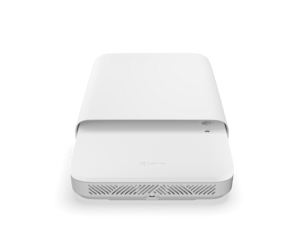
The new module is a replaceable sensor module for the Sensedge Mini that measures three gases: ozone, nitrogen dioxide, and carbon monoxide. It installs into one of the Mini's two sensor bays in about a minute, arrives pre-calibrated, and requires no on-site calibration step or return to the factory.
This is Kaiterra's modular design doing the job it was built for. Sensors live in replaceable modules, so a project can measure new parameters by changing a module rather than replacing the monitor.
What Is the WELL Air Concept, and What Does It Require?
The Air Concept sits at the core of WELL v2 and is the largest single concept in the standard. It contains preconditions that every certifying project must meet, and optimizations that projects can pursue for additional points.
Continuous monitoring of specific airborne pollutants sits at the center of the concept. WELL references six parameters directly: particulate matter (PM2.5 and PM10), carbon dioxide, total volatile organic compounds, ozone, nitrogen dioxide, and carbon monoxide. Projects can demonstrate compliance in one of two ways. The first is periodic on-site performance verification, which requires professional testing on an annual cadence and produces a snapshot in time. The second is continuous monitoring through the Sensor Data pathway, which produces a live dataset the project team and occupants can act on year-round.
For most certifying buildings, continuous monitoring is the more useful pathway. It removes the annual testing cost, produces trend data on how the building actually performs across seasons and occupancy patterns, and opens up optimization points that periodic testing does not. For projects pursuing WELL v2, the Sensedge Mini is now eligible for 3 preconditions and up to 9 optimization points across the Air and Thermal Comfort concepts.
| WELL v2 feature | Type | What it covers |
|---|---|---|
| A01 Air Quality | Precondition | Pollutant thresholds across the referenced parameters |
| A03 Ventilation Design | Precondition | Ventilation performance, verified through CO2 data |
| T01 Thermal Performance | Precondition | Temperature and humidity within comfort ranges |
| A05 Enhanced Air Quality | Optimization | Tighter pollutant thresholds than A01 |
| A06 Enhanced Ventilation Design | Optimization | Higher outdoor air rates, verified continuously |
| A08 Air Quality Monitoring and Awareness | Optimization | Continuous monitoring plus occupant-facing data |
| T06 Thermal Comfort Monitoring | Optimization | Continuous thermal condition monitoring |
| T07 Humidity Control | Optimization | Relative humidity held within a defined band |
What a given project actually earns depends on its scope and how the data gets used. A WELL AP or project coach can confirm what applies to a specific certification pathway.
Wired or Wireless: Choosing Your WELL Project's Deployment
Kaiterra now has two devices that measure every parameter required in WELL’s Air and Thermal Comfort concepts, and projects can pick whichever suits the building.
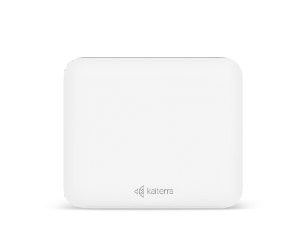
The Sensedge Go is wireless and battery-powered. It is the preferred choice when there is no power or data infrastructure at the sensing point, or where the building program calls for moving devices around as occupancy changes.
The Sensedge Mini is wired for both power and data. It suits buildings that want a permanent wall installation, native BACnet integration with a building management system, or the operational simplicity of never managing device batteries. As the only BTL-certified air quality monitor on the market, it has been the strong choice for BMS-integrated projects, and with this latest module, it now delivers the same WELL coverage as the Sensedge Go over that wired connection.
What Existing Sensedge Mini Users Can Do Today
Any Sensedge Mini already installed in a building can be upgraded in place. The new module can be placed into the same bay that current modules occupy, and the swap takes about a minute per device. There is no need to take the unit off the wall, re-mount, or schedule a service visit.
For customers with active or planned WELL projects, that means the upgraded parameters can come online on hardware already deployed, with no new device order and no factory return.
How to add ozone, nitrogen dioxide, and carbon monoxide monitoring to your Sensedge Mini
Where These Pollutants Matter Beyond WELL Certification
Buildings with no WELL scope and no traffic, combustion, or ionizing equipment nearby will find the default PM and TVOC configuration sufficient. Though several building types benefit from measuring ozone, nitrogen dioxide, and carbon monoxide for reasons that sit outside certification:
- Traffic-adjacent buildings. Ground-floor lobbies, mixed-use spaces with street-level ingress, and buildings within a block of major arterials show measurable indoor NO2 and CO from outdoor infiltration.
- Combustion-adjacent spaces. Test kitchens, cafeterias, and any space with unvented or partially vented gas appliances produce NO2 at concentrations continuous monitoring will detect long before an alarm-threshold CO sensor does.
- Spaces with ionizing air-cleaning equipment. Bipolar ionization HVAC add-ons, high-throughput print rooms, and some plasma-based purifiers generate ozone as a byproduct. Continuous measurement is the only way to confirm the equipment is not creating a second pollution problem.
- Buildings pursuing other certifications with continuous monitoring requirements. LEED v5 and RESET both reference these gases in continuous monitoring credits.
The WHO global air quality guidelines set reference values for all three gases, which is a useful starting point for any project setting internal thresholds outside a certification framework.
If you’re interested in learning more about how the Sensedge Mini can benefit your current or upcoming WELL project, reach out today to connect with a WELL AP on the Kaiterra team!
